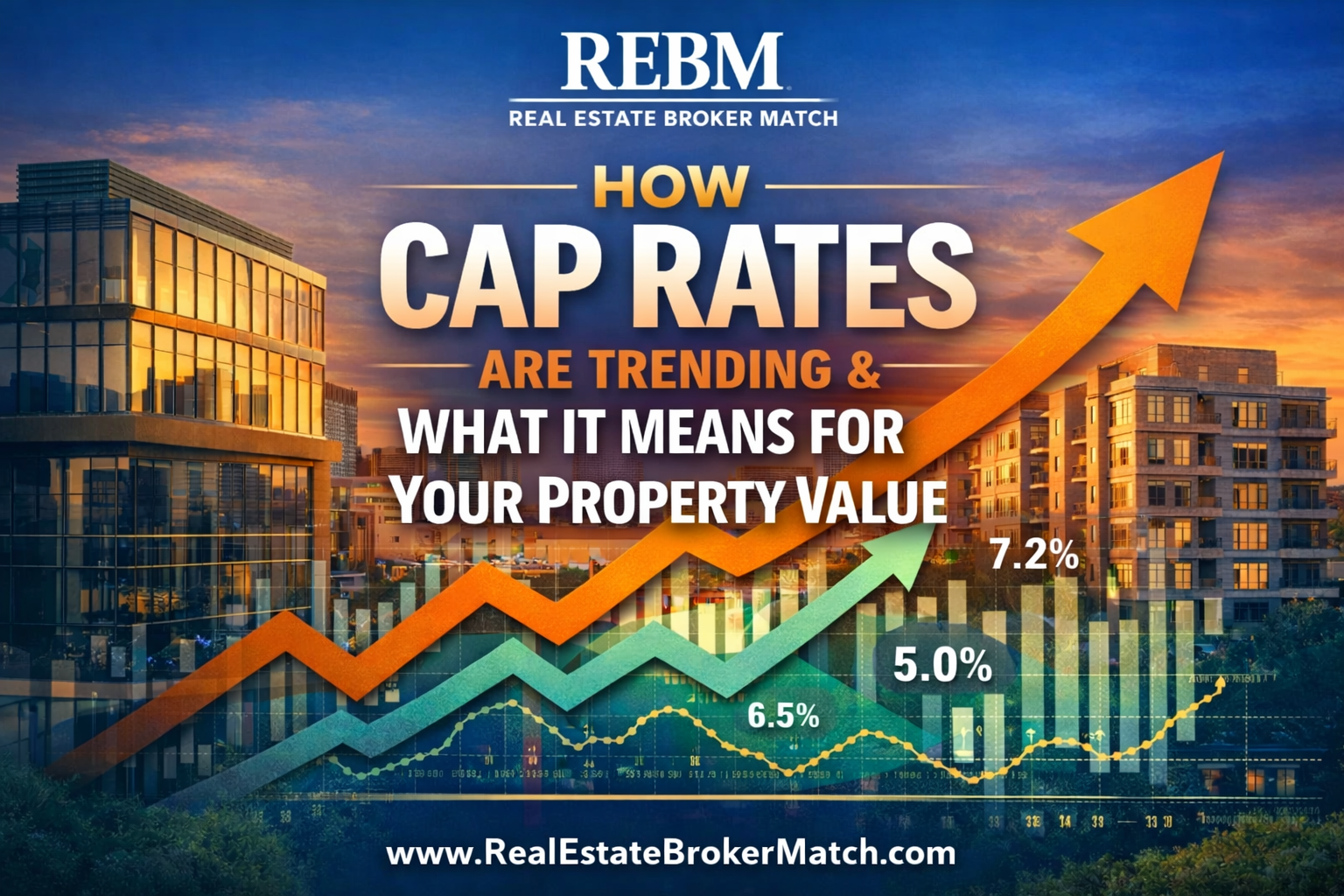
For commercial property owners considering a sale, few metrics matter more right now than cap rates. While many sellers focus on interest rates or headline market news, cap rate trends often have a more direct and immediate impact on property value, buyer behavior, and negotiation leverage.
Understanding how cap rates are moving and how buyers interpret them is critical for sellers who want to protect pricing and execute efficiently in today’s commercial real estate market.
What Cap Rates Represent to Buyers
One of the most common reasons commercial listings sit unsold is unrealistic pricing. Sellers often anchor to past valuations, peak market conditions, or informal opinions rather than current, data-driven market realities.
Commercial buyers underwrite income, risk, and future cash flow. If the asking price does not align with in-place rents, lease terms, operating expenses, or prevailing cap rates, buyers will move on quickly. This applies across all asset classes, whether the property is a single-tenant retail asset, a stabilized industrial facility, or a value-add multifamily deal.
Overpriced listings may still attract early inquiries, particularly when first launched. However, serious buyers disengage once underwriting fails to support the price. As time passes without traction, the market begins to view the listing as stale, which further reduces interest and weakens the seller’s negotiating position.
Where Cap Rates Have Been Trending
Over the past several market cycles, cap rates across most commercial asset classes have generally moved higher. Rising interest rates, tighter lending standards, and increased scrutiny on tenant performance have all contributed to this shift.
Buyers today are underwriting more conservatively than they were during periods of low-cost debt. Even well-located, stabilized assets are being evaluated with more caution. As a result, buyers are pushing for higher cap rates, particularly for assets with lease rollover risk, short weighted average lease terms, or operational complexity.
This trend does not mean properties are no longer desirable. It means buyers are repricing risk more carefully than before.
How Cap Rate Expansion Impacts Property Value
For sellers, rising cap rates usually translate into downward pressure on pricing unless offset by income growth.
If net operating income remains flat and cap rates expand, value declines mathematically. This is often where sellers feel frustrated, especially if the property has performed well operationally. From the buyer’s perspective, however, the adjustment reflects a change in required return, not a judgment on the asset’s quality.
Sellers who ignore cap rate trends often experience longer marketing periods, fewer qualified offers, and increased renegotiation during due diligence. Buyers will underwrite based on current market cap rates regardless of seller expectations.
Cap Rates Vary by Asset Class and Deal Structure
Not all cap rates move the same way or at the same pace. Retail, industrial, office, multifamily, mixed-use, and specialty assets each respond differently to market conditions.
Single-tenant retail assets with strong credit tenants may see more stability in cap rates than value-add office or mixed-use properties. Multifamily assets are often evaluated based on rent growth assumptions, while industrial buyers may focus more heavily on functionality and tenant rollover.
Sellers who apply broad market assumptions without an asset class context risk mispricing their property. Understanding where buyers are actually transacting within a specific sector is far more valuable than relying on national averages.
Why Timing Matters More in a Shifting Cap Rate Environment
When cap rates are moving, timing becomes a strategic decision rather than a simple scheduling issue.
In a rising cap rate environment, delays can cost sellers leverage. Buyers adjust underwriting quickly, and pricing expectations can shift in a matter of months. Sellers who wait too long to go to market often find that buyer feedback worsens even if the property itself has not changed.
Conversely, sellers who understand current cap rate dynamics and price accordingly at launch tend to preserve momentum and attract more serious interest early in the process. Early competition is one of the most effective ways to protect value.
Pricing Strategy Is Critical for Sellers
Correct pricing in a cap rate-sensitive market is not about discounting an asset. It is about aligning expectations with how buyers are underwriting risk today.
Overpricing based on outdated cap rate assumptions almost always backfires. Initial interest fades, time on market increases, and buyers gain leverage. Price reductions later are often deeper than if the asset had been priced correctly from the start.
Sellers who price realistically maintain control of the narrative and force buyers to compete on terms rather than simply negotiating price down.
How Cap Rates Affect Negotiations During Due Diligence
Cap rate assumptions rarely disappear once a deal is under contract. Buyers often revisit cap rates during due diligence, especially if new information emerges or market conditions shift.
Sellers who enter due diligence without a clear understanding of how their pricing aligns with current cap rates are vulnerable to retrades. Buyers may cite comparable sales, changes in financing terms, or perceived market softening to justify concessions.
Preparation is the best defense. Sellers who understand cap rate positioning and have market data to support pricing are far better equipped to push back during negotiations.
How REBM Helps Sellers Navigate Cap Rate Trends
Real Estate Broker Match helps property owners navigate cap rate trends by connecting them with brokers who specialize in the exact asset class and market of their property.
These brokers understand how buyers are underwriting deals today, where cap rates are actually clearing, and how to position assets to attract qualified demand. Rather than relying on generic assumptions, sellers receive guidance rooted in real transaction data and active buyer behavior.
This alignment helps sellers price accurately, market effectively, and negotiate confidently in a changing environment.
Sellers who stay informed, price strategically, and align with specialized representation are far better positioned to achieve strong outcomes, even in shifting markets.
If you are considering selling a commercial property and want clarity on how cap rates affect your asset, visit realestatebrokermatch.com to get matched with a broker who understands your market and knows how to protect value from start to finish.