Selling commercial real estate is not a passive transaction. Unlike residential sales driven by emotion and aesthetics, commercial real estate is a capital-markets process governed by pricing strategy, underwriting discipline, buyer psychology, tax timing, and leverage management.
Many property owners assume a broker’s role is limited to producing basic marketing materials, posting the property on LoopNet or CoStar, and waiting for the phone to ring. In reality, the quality of brokerage work is the primary variable that determines whether a seller maximizes their internal rate of return (IRR) or quietly leaves six or seven figures on the table.
This guide breaks down what a high-performing commercial real estate broker actually does for sellers and why your choice of representation is one of the most significant financial decisions you will make.
1. Commercial Real Estate Pricing Strategy: More Than a Comps Exercise
What sellers often think: A broker pulls a list of recent sales in the area and suggests a price based on the average price per square foot.
What strong brokers actually do: Professional commercial real estate brokers perform a sophisticated analysis of the property’s income stream to determine true market-clearing prices. They analyze lease structure to evaluate the durability of income across NNN leases, Modified Gross, and Full Service leases, while factoring in tenant creditworthiness, lease rollover risk, and upcoming capital expenditures.
They also anticipate buyer underwriting, assessing how institutional investors, private equity firms, and local syndicators will calculate yield on cost and risk-adjusted returns.
Why this matters: In commercial real estate, overpricing kills momentum. If a property sits on the market too long, it becomes stigmatized. Conversely, underpricing sacrifices massive value. The right pricing strategy creates competitive tension, which is the only way to drive a price above the market average.
2. Identifying the Right Commercial Property Buyer Pool
What sellers often think: Maximum exposure to the general public leads to the best outcome.
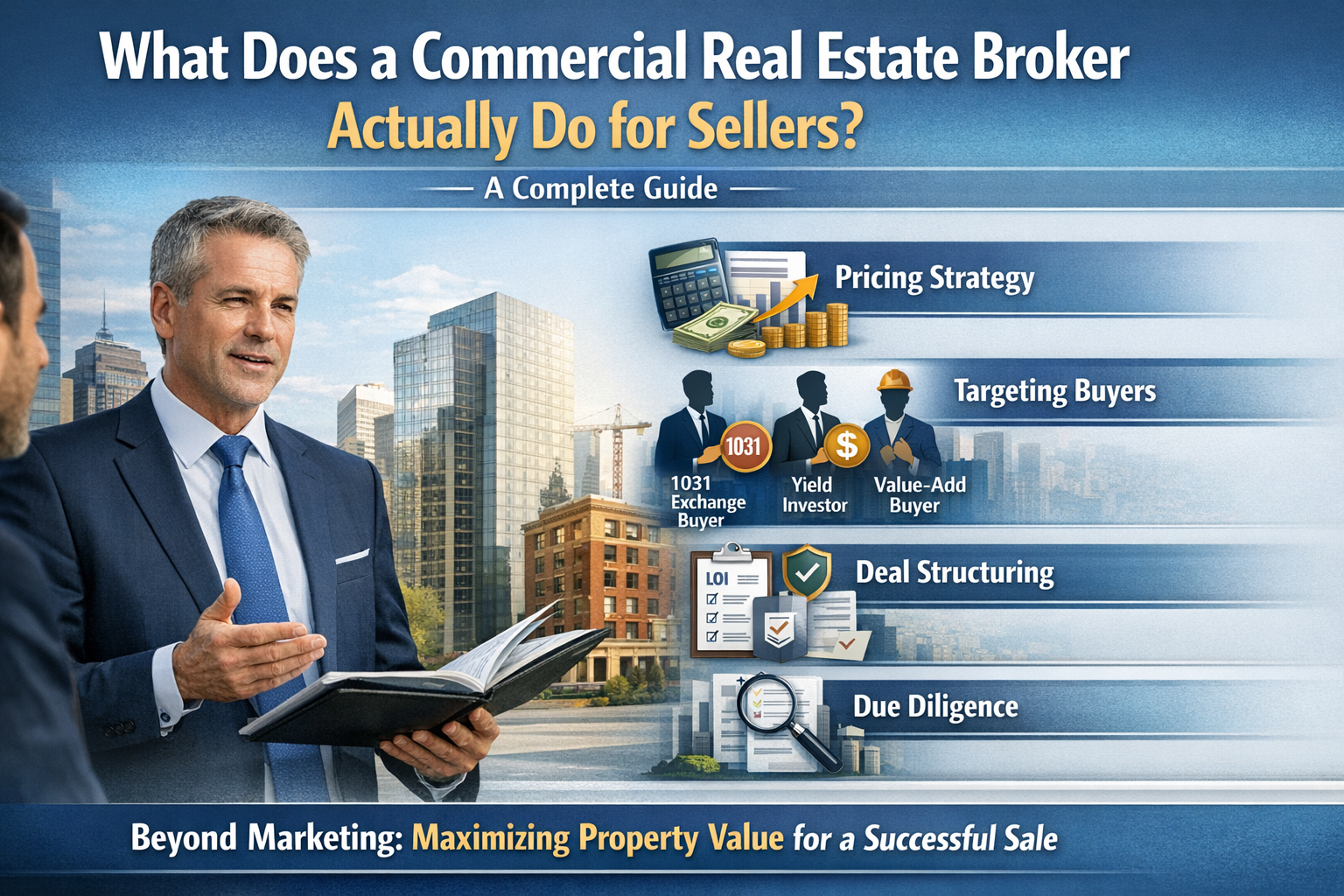
What strong brokers actually do: A top-tier commercial real estate broker understands that not all capital is created equal. They segment the market to find the most aggressive capital for your specific asset class, targeting:
- 1031 Exchange Buyers under strict IRS timelines who need to close quickly
- Yield-Focused Investors seeking stable cash flow from retail, office, or industrial properties
- Value-Add Players looking for properties with vacancy or renovation potential
Why this matters: The highest-quality offer rarely comes from a generic mass-email blast; it comes from a buyer whose specific investment mandate aligns with your property’s profile. Different buyer types underwrite risk differently, which directly impacts valuation, terms, and certainty of close.
3. Positioning Your Commercial Asset: The Story Behind the Numbers
What sellers often think: The profit and loss (P&L) statements speak for themselves.
What strong brokers actually do: Commercial real estate trades on narrative as much as math. A skilled broker’s job is to frame a clear investment thesis. They don’t just present the current Rent Roll; they highlight the pro-forma potential and proactively manage risk perception by addressing objections before they surface.
For example, if a major tenant is leaving in two years, a strong broker presents a re-tenanting strategy and market data showing high demand for that space.
Why this matters: Weak positioning undermines offers before negotiations even begin. If a buyer views an asset as risky, they will bake a higher risk premium into their cap rate, resulting in a lower offer for the seller.
4. Managing the Commercial Property Marketing Process
What sellers often think: Marketing means posting the listing on CoStar and LoopNet.
What strong brokers actually do: Effective marketing for commercial properties is about controlled outreach. Professional brokers use proprietary databases to reach out directly to acquisition principals at REITs, private equity firms, and family offices. They:
- Manage a virtual data room to ensure all property information is organized and professional
- Time the release of information to maintain a sense of urgency
- Maintain consistent messaging across all buyer touchpoints
Why this matters: Uncontrolled marketing leads to stale listings and buyer fatigue. If every broker in town knows your property is for sale but no one knows why, the asset loses its luster. A disciplined process preserves your negotiating leverage.
5. Commercial Real Estate Negotiation and Deal Structuring
What sellers often think: Negotiation starts after a Letter of Intent (LOI) is submitted.
What strong brokers actually do: Negotiation begins the moment a broker takes the first phone call from a potential buyer. A seasoned commercial real estate broker shapes the terms before the LOI is finalized, evaluating offers based on net proceeds rather than just the headline price. They analyze:
- Hard Money Deposits: Ensuring the buyer has significant skin in the game
- Contingencies: For example, a financing contingency in a volatile rate environment can shift pricing risk back onto the seller
- Closing Timelines: Managing the length of the feasibility period to protect the seller
Why this matters: A high offer with loose terms is often worth less than a slightly lower offer with a short closing window and no contingencies. Most value is created or lost during the structuring of the deal.
6. Navigating Due Diligence and Closing on Commercial Property Sales
What sellers often think: Once the contract is signed, the outcome is fixed.
What strong brokers actually do: This is the most volatile stage of the transaction. A professional broker acts as the project manager, coordinating between lenders, attorneys, and inspectors. Diligence requests are managed to prevent scope creep, while pressure is maintained on milestones to reduce retrade risk—the phenomenon where a buyer attempts to reprice the transaction over immaterial diligence findings.
Why this matters: Late-stage deal failures are common in commercial real estate. A strong broker reduces this risk by controlling the information flow and maintaining the buyer’s focus on the original investment thesis.
7. Local vs. National Commercial Real Estate Brokerage: When Each Matters
Choosing the right brokerage model depends on the asset type:
Local commercial real estate expertise is crucial for market-specific assets where the buyer is likely a local investor who values knowledge of city zoning, neighborhood dynamics, and local market conditions.
National commercial real estate reach is essential for institutional-grade assets or niche properties where the buyer pool is global, such as large multifamily complexes, Class A office buildings, or specialized industrial facilities.
Often, an individual broker’s specialization in a specific asset class (retail, office, industrial, multifamily, hospitality, or land) outweighs the brand recognition of their firm. The optimal choice depends on where pricing power is coming from: local market knowledge or access to specialized capital.
Selecting the wrong brokerage model misaligns the asset with its natural buyer pool and directly suppresses pricing.
How to Choose the Right Commercial Real Estate Broker for Selling Your Property
Understanding what strong brokers actually do is the first step. Identifying which brokers consistently execute this work well for your specific asset is the harder part. Consider:
- Track record with your specific property type (retail, office, industrial, multifamily, land)
- Buyer network that matches your asset’s profile
- Market expertise in your geography or asset class
- Deal structuring experience that maximizes your net proceeds
Conclusion: Broker Selection Is a Critical Investment Decision
If you are considering selling a commercial property and want to ensure you are working with the right broker, Real Estate Broker Match (REBM) helps sellers get matched with vetted commercial real estate brokers based on property type, geography, and buyer pool alignment.
Contact Real Estate Broker Match to discuss your property and get matched with the best commercial real estate broker for your needs.