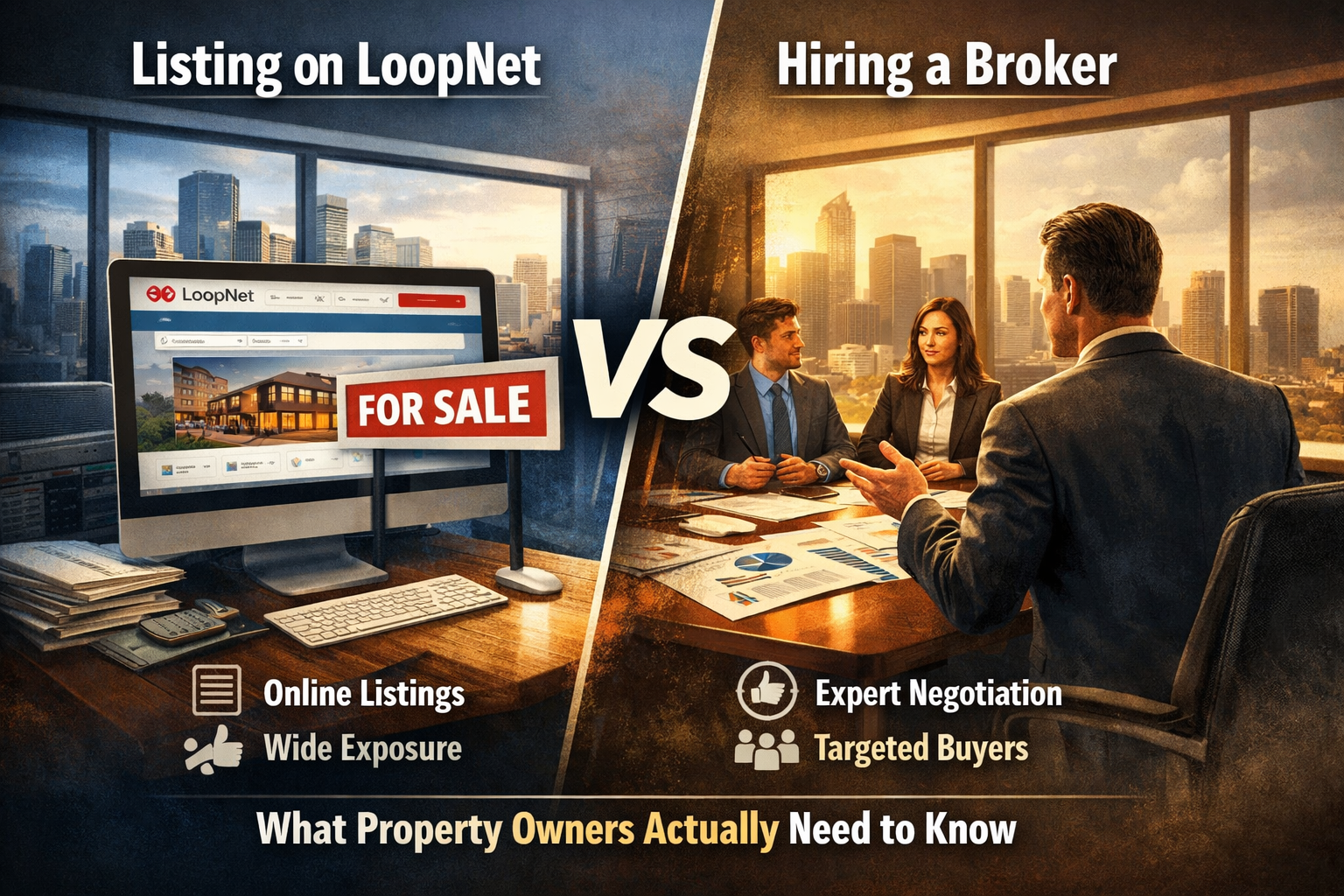
For most commercial property owners, the decision to sell triggers a predictable internal debate. On one hand, you have LoopNet, the industry’s largest public-facing marketplace. On the other, you have the traditional path: hiring a commercial real estate broker.
The choice often feels like a simple math problem: “Can I save the 3–6% commission by listing the property on LoopNet myself?”
It feels like a rational question. It just happens to be the wrong one. In reality, viewing this as a choice between a website and a professional is a fundamental misunderstanding of how capital markets work. Selling commercial real estate isn’t a classifieds exercise; it is a high-stakes process of engineering competitive tension.
In this guide, we’ll break down why a LoopNet listing is a tool—not a strategy—and how the decision you make impacts your final proceeds far more than a commission check ever will.
What Listing on LoopNet Actually Does for Commercial Property Owners
To understand the LoopNet vs. broker debate, you first have to understand what the platform actually provides. Owned by CoStar, LoopNet is a massive advertising platform. It is essentially a digital billboard designed for maximum visibility. For many brokers and owners, that visibility can be useful when deployed correctly within a larger framework.
What LoopNet Provides:
- Broad Exposure: It surfaces your property to local investors, casual browsers, and active buyers.
- Information Distribution: It hosts your offering memorandum, photos, and basic financial data.
- Lead Generation: It provides a contact portal that allows anyone with an internet connection to reach out.
What LoopNet Does Not Do:
- Price Strategy: It cannot tell you if your Cap Rate is aggressive or if you are leaving money on the table.
- Vetting: It doesn’t filter out unqualified buyers who may waste months of your time during the commercial property sale process.
- Narrative Control: It cannot frame the “story” of the asset to justify a premium valuation.
- Leverage: It does not manage a timeline to force buyers into a “best and final” scenario.
The Hidden Cost of Avoiding Broker Commissions
The primary motivation to sell commercial property without a broker is almost always the commission. On a $5 million deal, a 5% commission is $250,000. That feels like a tangible loss.
However, in commercial real estate, value leakage is often invisible. If an owner lists a property for $5 million on LoopNet and receives a full-price offer, they feel they’ve succeeded. But what if a specialized commercial real estate broker, using a controlled process and institutional contacts, could have driven that price to $5.4 million?
By trying to save $250,000, the owner actually lost $150,000 in net proceeds and took on the full burden of execution, diligence coordination, and deal risk. One weak negotiation point or an incorrectly handled “re-trade”—where a buyer drops the price during due diligence—can wipe out years of Net Operating Income (NOI).
How Mispricing Happens Without Professional Guidance
In residential real estate, pricing is a “comps” exercise. In commercial real estate, property valuation is an outcome of underwriting. Buyers look at risk tolerance, cost of capital, and tax postures like 1031 exchanges.
When you create a LoopNet listing yourself, you risk two major pitfalls:
- Overpricing: The listing sits for six months and becomes stale. In many cases, a publicly listed owner-direct deal can signal that professional channels were bypassed or that the process lacks institutional sponsorship, which reduces urgency among institutional buyers.
- Underpricing: You receive five offers in 48 hours. While this feels like a success, it is a glaring signal that you priced the asset too low and missed out on significant “blue sky” value.
A high-performing broker uses price elasticity testing—reaching out to shadow buyers before a public listing—to find the exact ceiling of the market.
Buyer Quality: LoopNet Leads vs. Broker-Sourced Buyers
There is a massive difference between an email lead and a qualified commercial real estate buyer.
LoopNet inbound leads often include small-scale investors just browsing, uncapitalized buyers looking for owner-financing, or other brokers seeking a listing.
Most institutional buyers rely primarily on broker relationships rather than public marketplaces for deal flow. They prioritize off-market commercial real estate opportunities because those deals have been vetted. Furthermore, these buyers expect tight timelines, clean data rooms, and competitive processes—not open-ended negotiations with unknown counterparties.
Not All Brokers Add Value
It is a mistake to assume that simply hiring any broker is the solution. The quality of representation varies wildly in this industry:
- The “Post-and-Pray” Broker: They take your listing, upload it to LoopNet, and wait for the phone to ring. This is essentially the same as listing it yourself, just more expensive.
- The Process Manager: They engineer a competitive environment, vet every lead, and defend your price against re-trades.
The delta between these two types of brokers can represent hundreds of thousands of dollars. In larger transactions, it can mean the difference between a single-buyer negotiation and a true best-and-final process. Hiring a commercial real estate broker is only a winning strategy if that broker has a specific track record with your asset type and geography.
Brokerage Is Process Engineering, Not Marketing
A professional broker does not simply “list” a property—they run a sale process designed to control information, timing, and leverage to maximize sale price:
| Stage | What a Broker Actually Does |
| Pre-Market | Financial audit, lease abstraction, and asset positioning to justify the price. |
| Controlled Exposure | Targeted outreach to “likely suspects” and institutional buyers before going public. |
| Competitive Tension | Managing “Call-for-Offer” dates to force buyers to compete against each other. |
| Negotiation | Defending against re-trades, managing risk allocation, and perfecting the close. |
When LoopNet-Only Might Actually Make Sense
Is there ever a time to sell commercial real estate without a broker? Yes. In some situations, the commercial property sale is simple enough that a full brokerage process may not materially improve outcomes. This might apply if:
- You are selling a small, commoditized asset (e.g., a $500k small office condo).
- You already have a highly motivated buyer (like a neighboring tenant) and just need a lawyer to handle the paperwork.
- The property is a simple “owner-user” building where the buyer is a local business owner, not an investment fund.
Even in these cases, paying a professional for a Broker Opinion of Value (BOV) is usually money well spent to ensure you aren’t leaving money on the table.
The Real Question Owners Should Be Asking
The question isn’t “Should I use LoopNet?”—professional brokers use it too. The real question is: “Who is running the process?”
LoopNet shows your property to the market. A broker shapes how the market responds. LoopNet is a database that provides visibility; a broker is a leverage manager who provides results. In commercial real estate, that difference compounds quietly—but materially—into real money.
How REBM Helps You Navigate This
At Real Estate Broker Match (REBM), we believe that the wrong broker is often worse than no broker at all. We help property owners bypass the guesswork by matching them with pre-vetted brokers who specialize in their specific asset class, market, and transaction size.
If you’re deciding whether your property requires a full sale process or limited exposure, we can connect you with the right expertise to ensure you maximize commercial property value.