Commercial real estate listings rarely fail because there is no demand. In most cases, properties sit unsold for months due to preventable issues related to pricing, positioning, broker strategy, and market exposure. Across retail, office, industrial, multifamily, and specialty asset classes, the same patterns tend to repeat regardless of market size or location.
When a listing lingers, it does more than delay a sale. Time on market directly impacts perception. Sellers lose negotiating leverage, and buyers begin to question why a property has not traded. Understanding the real reasons commercial listings stall is essential for sellers who want to protect value and execute efficiently. Below are the most common causes of prolonged marketing periods and how they affect outcomes across all asset classes.
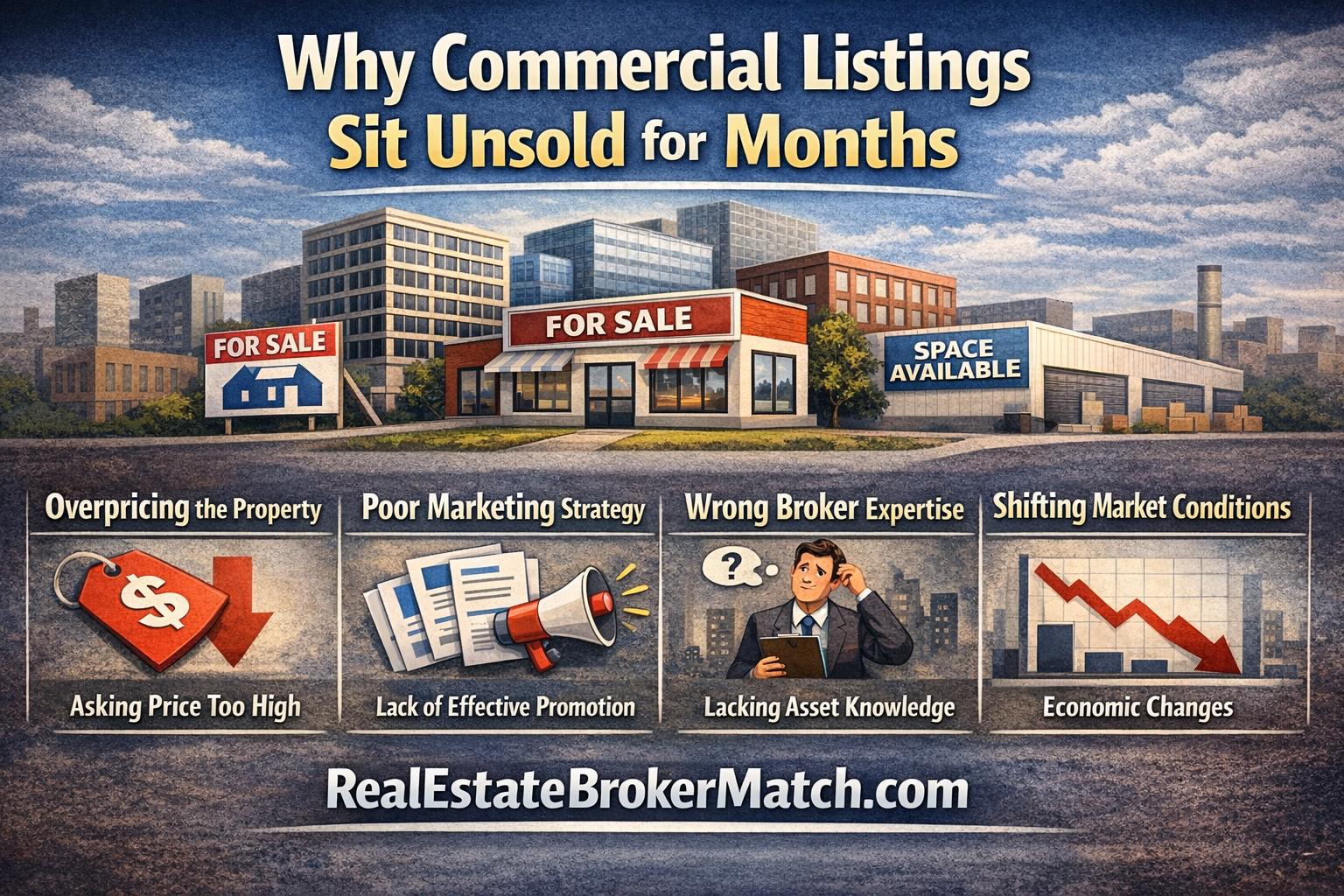
Overpricing Relative to Market Reality
One of the most common reasons commercial listings sit unsold is unrealistic pricing. Sellers often anchor to past valuations, peak market conditions, or informal opinions rather than current, data-driven market realities.
Commercial buyers underwrite income, risk, and future cash flow. If the asking price does not align with in-place rents, lease terms, operating expenses, or prevailing cap rates, buyers will move on quickly. This applies across all asset classes, whether the property is a single-tenant retail asset, a stabilized industrial facility, or a value-add multifamily deal.
Overpriced listings may still attract early inquiries, particularly when first launched. However, serious buyers disengage once underwriting fails to support the price. As time passes without traction, the market begins to view the listing as stale, which further reduces interest and weakens the seller’s negotiating position.
Weak or Incomplete Marketing Strategy
Many commercial listings struggle due to poor or incomplete marketing execution. Generic offering memorandums, limited outreach, and unclear financials often fail to communicate why a property is compelling in the current market.
Effective commercial marketing goes far beyond posting a listing. Buyers expect detailed rent rolls, transparent expense data, lease summaries, and a clear investment narrative. Without these elements, buyers are forced to make assumptions, which usually work against the seller.
This issue is especially damaging for out-of-state and institutional buyers who rely heavily on marketing materials to evaluate opportunities efficiently. When information is missing or unclear, buyers either disengage or discount pricing to compensate for uncertainty.
Misaligned Broker Expertise
Commercial real estate is highly specialized, yet many listings are handled by brokers without deep experience in the specific asset class being sold.
Each sector attracts a different buyer pool and requires a different underwriting approach. Retail investors focus on tenant credit and lease structure. Industrial buyers analyze functionality, logistics, and location efficiency. Multifamily investors prioritize operating performance, unit mix, and rent growth potential.
When a broker lacks asset class expertise, properties are often mispositioned or marketed to the wrong audience. This leads to wasted time, inconsistent feedback, and extended time on market. In many cases, the asset itself is strong, but the execution is not.
Limited Buyer Exposure
Some listings remain unsold simply because they are not reaching enough qualified buyers. Relying solely on local networks can significantly limit demand, particularly when a property may appeal to regional or national investors.
Today’s buyer pool is increasingly mobile. Exchange buyers, family offices, private equity groups, and high-net-worth investors often search across multiple markets for opportunities that meet specific criteria. If a listing is not broadly exposed, competition remains low, and pricing suffers.
Limited exposure also reduces urgency. Without multiple buyers engaging at once, sellers lose leverage and negotiations slow, even when the asset is well-located and fundamentally sound.
Unrealistic Seller Expectations on Terms
Pricing is only one component of a successful transaction. Inflexible expectations around deal structure can also stall or prevent sales.
Strict positions on closing timelines, financing contingencies, lease assumptions, or repair responsibilities often deter otherwise qualified buyers. In uncertain or shifting markets, buyers value flexibility, and sellers who refuse to adapt may see deals fall apart late in the process.
Sellers who remain rigid as market conditions evolve frequently experience longer marketing periods and increased pressure to concede later. Early flexibility often leads to stronger outcomes than delayed compromise.
Changing Market Conditions
Commercial real estate markets are constantly influenced by interest rates, lending conditions, tenant demand, and broader economic trends. What worked six months ago may no longer align with buyer expectations today.
Listings that were appropriately priced at launch can quickly become uncompetitive if sellers fail to reassess strategy as conditions change. Buyers adjust underwriting assumptions rapidly, and sellers who do not adapt often experience declining activity.
Staying aligned with current market realities is essential to keeping listings competitive and maintaining buyer interest throughout the marketing process.
How REBM Helps Prevent Stale Listings
Real Estate Broker Match helps sellers avoid these common pitfalls by connecting them with brokers who specialize in the exact asset class and market of their property.
Rather than taking a one-size-fits-all approach, REBM matches sellers with professionals who understand how buyers underwrite specific assets, where qualified demand comes from, and how to position properties effectively in the current market.
This alignment leads to better pricing guidance, stronger marketing execution, broader exposure, and more efficient deal execution. If your commercial property has been sitting longer than expected or you want to prevent that outcome altogether, visit RealEstateBrokerMatch.com to get matched with a broker who understands your asset class and knows how to move your listing forward.